

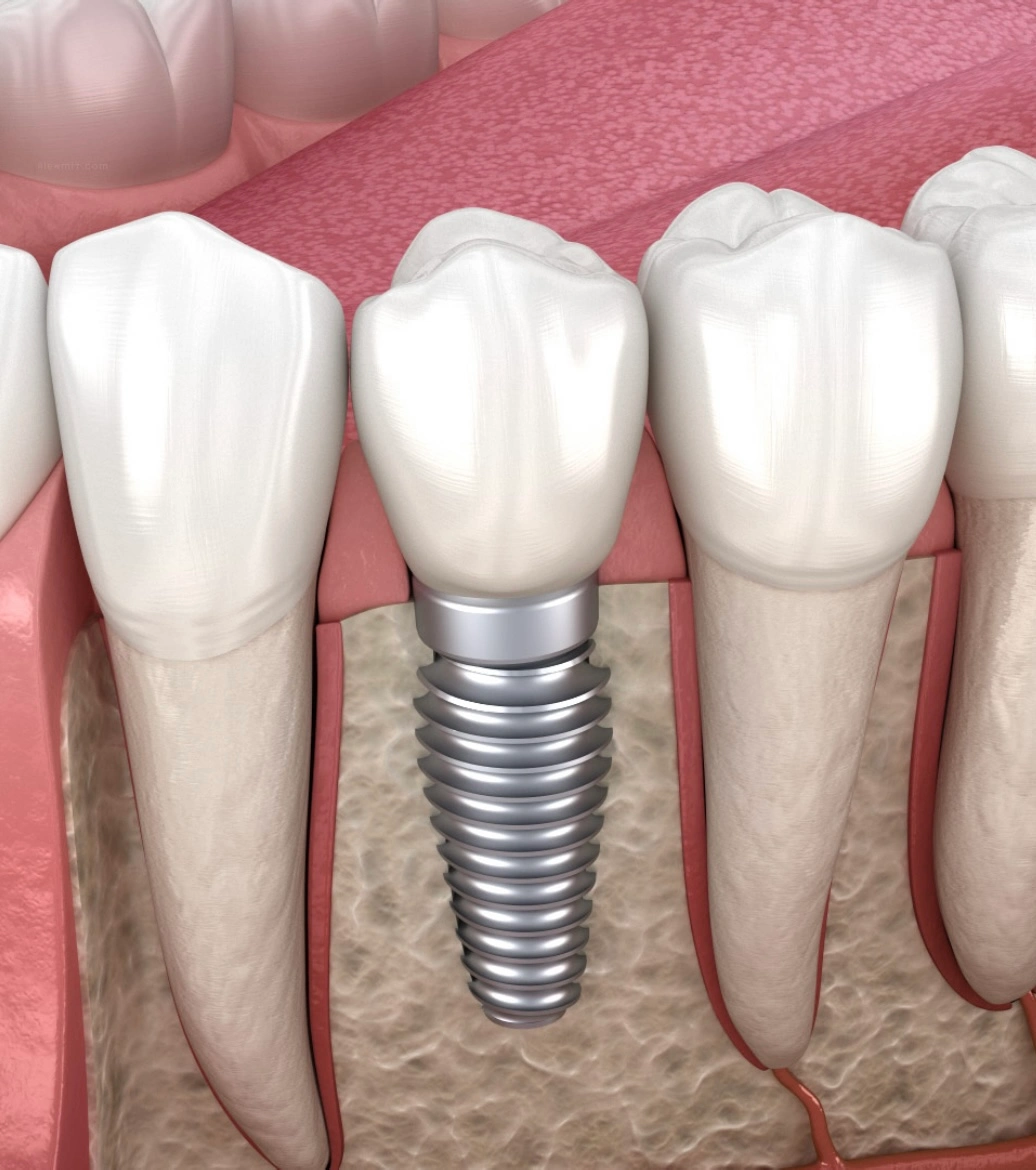
Implant Treatment is the process of integrating titanium-based artificial tooth roots into the jawbone to replace natural teeth lost functionally and aesthetically. This treatment is the gold standard applied for the rehabilitation of missing teeth in modern dentistry.
It is not just a "tooth replacement" procedure, but also a surgical protective shield that stops the alveolar bone resorption (atrophy) that develops due to tooth loss.
Treatment Details
Biocompatibility and Osseointegration
The implants we use are made of pure titanium, which shows excellent biological compatibility with the human body. The osseointegration process that takes place after placement enables bone cells to firmly attach to the implant surface. In this way, the implant, like a natural tooth root, transmits chewing forces directly to the bone and keeps the bone tissue alive.
Advanced Surgery and Bone Deficiencies
Implant application is possible even in cases where the jawbone volume is insufficient. Advanced surgical methods applied in our clinic:
- Sinus Lifting: Creating suitable bone volume for the implant by lifting the sagging sinus cavities in the upper jaw.
- Bone Graft (Bone Powder): Strengthening the implant socket by adding synthetic or natural bone powder to areas with bone loss.
Surgical Discipline:
Implant success is a combination of correct planning, sterilization protocols and the dentist's experience. With digital panoramic X-ray analysis, the angle and position of each implant are determined to the millimeter.
A Modern Approach to Full Edentulism
For patients with no teeth in their mouth, All-on-4/6 techniques fixed on 4 or 6 implants are applied instead of removable (palate) dentures. With this method, our patients are completely freed from problems such as knocking, slipping and loss of taste caused by removable dentures, and gain the comfort of fixed teeth.
How Implants Differ from Other Methods
While neighboring teeth are sacrificed in traditional bridges, in implant treatment the neighboring teeth are left untouched. The implant is placed into the jaw as an independent structure and relieves the load on the adjacent teeth. With proper care, it is the most economical long-term investment, offering lifelong use.
Medical Facts About Implants
Thanks to the anti-allergic nature of titanium, rejection of the implant by the body is not possible. Failure cases usually result from lack of hygiene or insufficient bone support.
Yes. In diabetics whose HbA1c values are under control and who proceed in coordination with their doctor, implant success is the same as in healthy individuals.
Implants are made of biocompatible pure titanium; therefore, the body rejecting the implant as a "foreign substance" or causing an allergy is not possible. The failure rate is very low, around 1-2%, and usually results from inadequate oral hygiene.
With proper planning and good oral care, implants can be used for a lifetime. As long as you give your implants the same care (brushing and flossing) you give your own natural teeth, they offer trouble-free use.