

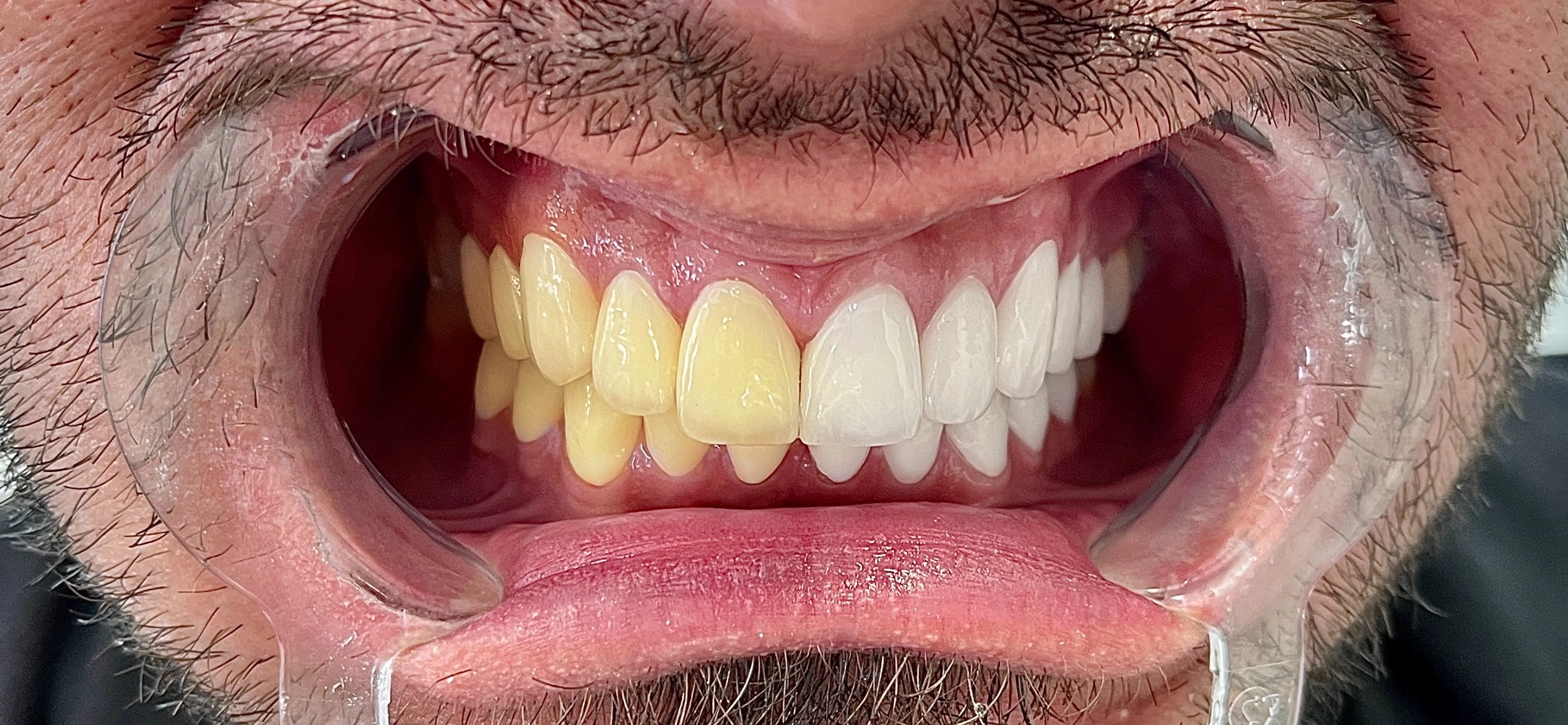
Teeth Whitening (Bleaching) is an aesthetic solution applied to remove discoloration that forms within the structure of the teeth (in the enamel and dentin layers) and to lighten the tooth shade by several degrees. Unlike scaling (tartar removal), it aims to whiten the tooth's own color.
Whiteness lost due to tea, coffee, cigarette use or genetic factors can be regained safely with modern agents applied under a dentist's supervision.
Contents
Why Do Teeth Change Color?
Discoloration on teeth is divided into two. Extrinsic discoloration forms on the surface due to factors such as food dyes, coffee and cigarettes. Intrinsic discoloration refers to stains that form during the development of the tooth or penetrate into the tissue due to medication use. The whitening process can give effective results in both cases.
In-Office Whitening (Office Bleaching)
This is the fastest method, with which we obtain results in a short time of about 45-60 minutes in the clinic environment.
- Dentist Supervision: The gums are protected with a special barrier and high-concentration whitening gel is applied to the teeth.
- Light Activation: The effect of the gel is activated with special light sources (laser or LED) to provide rapid whitening.
- Fast Result: A noticeable lightening of the tooth color is achieved in a single session.
Expert Note:
Cleaning any tartar before the whitening procedure ensures full contact of the gel with the tooth surface and increases the success of the treatment.
Home Whitening (Home Bleaching)
This is a method the patient applies at home using custom-made clear trays prepared from impressions taken by the dentist. Low-concentration gels are placed inside the trays and worn for a few hours a day, with the process completed within 1-2 weeks.
Maintaining Whiteness After Treatment
The first 48 hours after the procedure are called the "white diet" period. During this time, since the enamel is prone to staining, staying away from intensely colored foods such as wine, coffee, tomato paste and sour cherry juice maximizes the longevity of the result.
Frequently Asked Questions
There is no medical evidence that professional whitening performed under a dentist's supervision causes permanent damage to the enamel structure. It is a safe procedure.
Mild tingling or hot-cold sensitivity for 24 hours after application is normal and resolves on its own.
There is no pain during the procedure. However, a mild sensitivity to hot and cold during the first 24 hours is normal; this resolves on its own.
In-office whitening applied in the clinic takes about 45 to 60 minutes. The targeted whiteness is usually achieved in a single session.